
Sargassum biorefinery · Geneva · Caribbean · French Guiana
Turning a pollution into a resource.
A cascade biorefinery for stranded Caribbean and Atlantic sargassum.
Revalena is developing a cascade biorefinery that cleans up stranded sargassum: it captures the arsenic and heavy metals the seaweed concentrates, recovers its valuable molecules and turns the residue into renewable energy.
The project
A recurring environmental burden, with no industrial treatment route
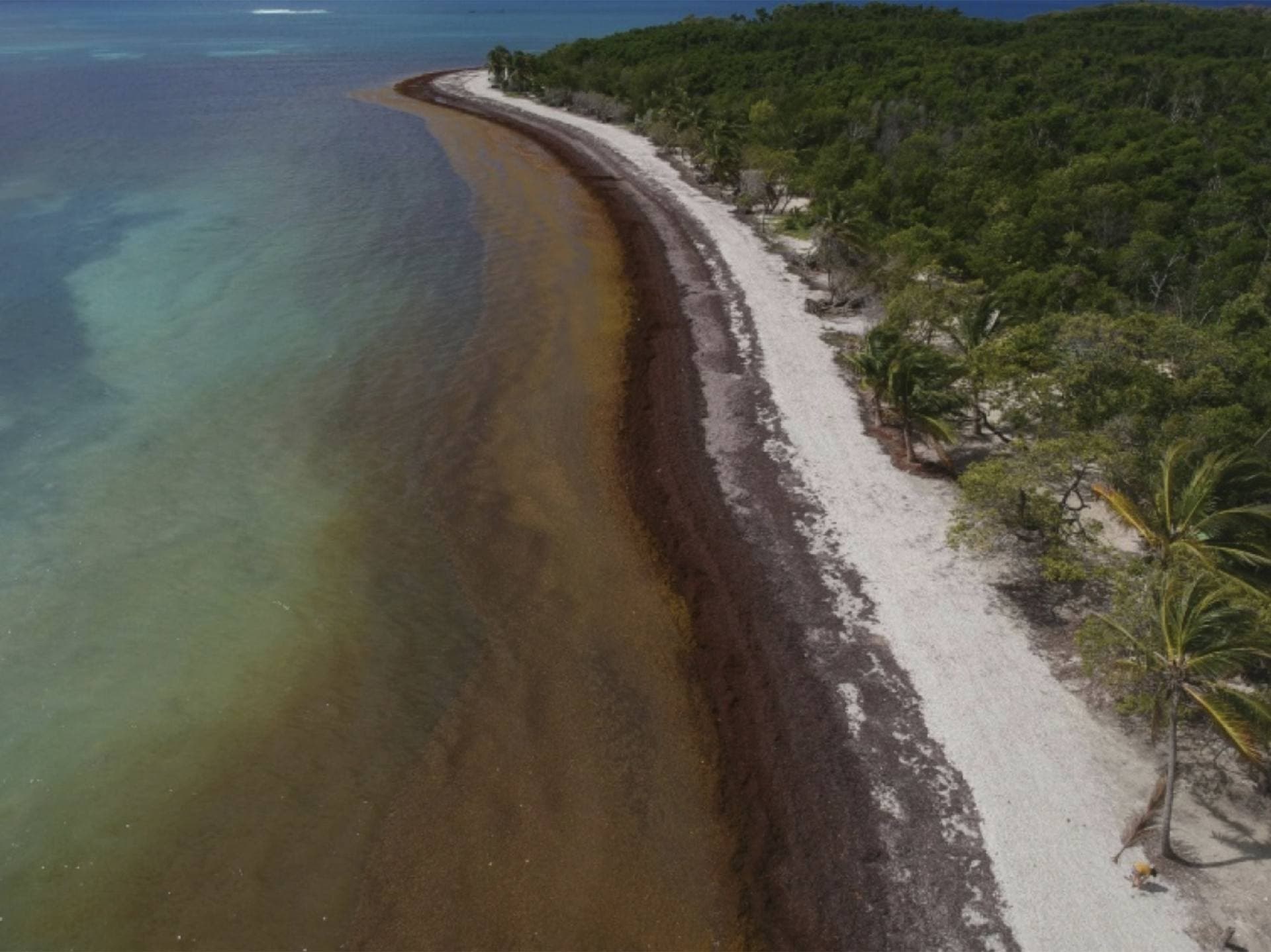
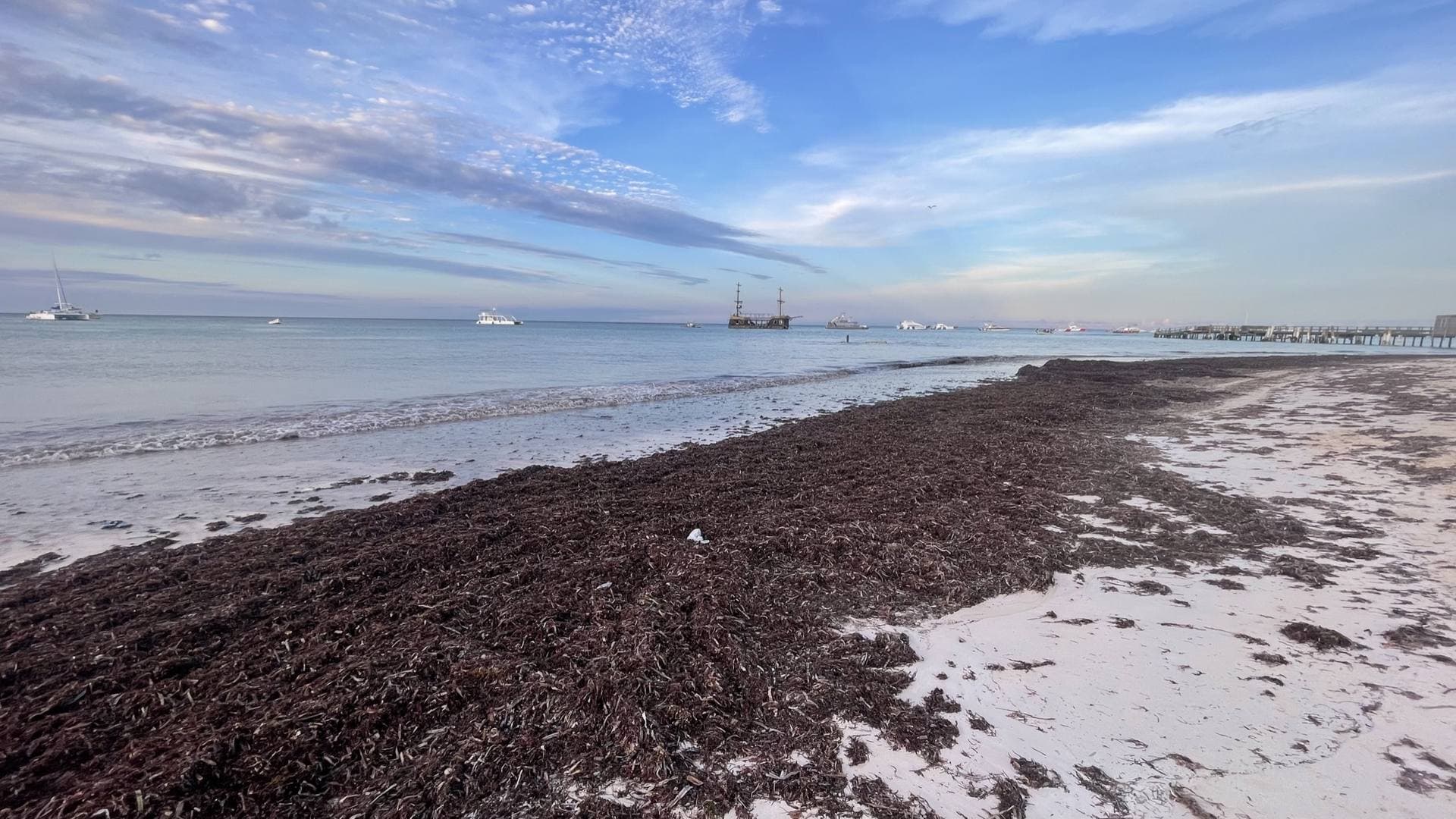
Since 2011, massive sargassum strandings have affected more than forty Caribbean territories. They damage coastal ecosystems and tourism, disrupt fishing and navigation, and expose coastal populations to hydrogen sulphide released as the seaweed decomposes.
128mg/kg
Arsenic content on a dry basis, which rules out most agricultural uses of the raw seaweed.
Source: CADE-2489 hydrothermal gasification study · CADE Soluciones de Ingeniería (Albacete, Spain), Apr 2026
Today, public money is spent clearing beaches and landfilling the biomass, where it keeps emitting methane and hydrogen sulphide uncontrolled, and where the arsenic it carries can leach into soils and water. Revalena treats this material as a resource: recover its valuable molecules first, then convert the residue into renewable gas, while locking the contaminants into an inert mineral fraction.
- Chlorine
- 17.6%
- Moisture
- 84.7%
Now let's understand how it works.
The cascade biorefinery
Extract, depollute, convert
Gasification is only one stage of a wider process. Before reaching the reactor, the biomass is pretreated to remove most of its contaminants, then passes through a cascade extraction of high-value molecules, recovered while they are still intact.
The loop closes on itself: the washing water is gasified in turn, which fixes the arsenic it carries in the salt fraction and recovers the dissolved organic carbon.
- of arsenic removed at pretreatment
- ~70%
- of arsenic removed at pretreatment
- of the remainder fixed in inert salts
- 65–85%
- of the remainder fixed in inert salts
- integral valorisation
- Zero waste
- integral valorisation
- Dominican Republic & French Guiana
- 2 axes
- Dominican Republic & French Guiana
- Stage 1
Pretreatment
Washing and pressing remove most of the chlorine and about ~70% of the arsenic.
This is what makes the biomass safe to process further. Washing and pressing extract most of the arsenic upstream; the washing water is itself gasified downstream, so what it carries also ends up in the salt fraction.
- Chlorine
- 17.55 → 0.41 wt.%
- Arsenic removed
- ~70%
Source: CADE-2489 hydrothermal gasification study · CADE Soluciones de Ingeniería (Albacete, Spain), Apr 2026
- Stage 2
Cascade extraction
Six compounds under study, identified from measured concentrations, recovered while still intact.
Developed under SARGASOL with the Grand Port Maritime de Guyane. High-value molecules are extracted before the residual biomass reaches the reactor. No compound has been selected at this stage: the final choice depends on extraction yields, achievable purity and profitability.
- Compounds under study
- 6
Under studySource: SARGASOL programme (ADEME / ANR) · ADEME · French National Research Agency (ANR), 2026
- Stage 3
Hydrothermal gasification
The extraction residue is treated in supercritical water — the one route whose economics improve with a wet feedstock.
Water is pressurised and preheated by recovering heat from the outgoing streams before reaching reaction temperature. A patented feed system introduces solid biomass continuously into the reactor — validated on real sargassum at CADE's pilot platform in Albacete.
- Pressure
- 250 bar
- Temperature
- 450–550 °C
Source: CADE-2489 hydrothermal gasification study · CADE Soluciones de Ingeniería (Albacete, Spain), Apr 2026
- Stage 4
Outputs
A renewable gas, arsenic fixed in inert mineral salts, and treated water returned to the circuit.
The renewable gas can be upgraded to methane or liquid fuels. The loop closes on itself: washing water is gasified in turn, which fixes the arsenic it carries in the salt fraction and recovers dissolved organic carbon.
- Output streams
- 3
Source: CADE-2489 hydrothermal gasification study · CADE Soluciones de Ingeniería (Albacete, Spain), Apr 2026
The technology
CADE's supercritical water gasification
Water is pressurised and preheated by recovering heat from the outgoing streams before reaching reaction temperature. A patented feed system introduces solid biomass continuously into the reactor — validated on real sargassum at CADE's pilot platform in Albacete.
250bar
Gasification pressure
450–550°C
Gasification temperature
7runs
Gasification runs completed
Source: CADE-2489 hydrothermal gasification study · CADE Soluciones de Ingeniería (Albacete, Spain), Apr 2026
Cascade extraction
Six compounds under study
Concentrations measured at 3 sites, Dominican Republic, January 2026.
Fucoxanthin
Marine carotenoid · nutraceutical and cosmetic
up to 6.33 mg/100 g
Under studyFucosterol
Major phytosterol · cosmetic and nutraceutical
605 to 1,126 µg/g
Under studyFucoidan
Sulfated polysaccharide · health and nutraceutical
High-value compound
Under studyAlginates
Gelling polysaccharide · industrial uses
Industrial grade
Under studyFlavonoids
Antioxidant polyphenols · cosmetic and nutraceutical
92 to 346 mg/100 g
Under studyBiostimulants
Agricultural extracts · crop stimulation
Agronomic value
Under study
No compound has been selected at this stage: the final choice will depend on extraction yields, achievable purity and profitability, which remain to be established through pilot validation. Beta-carotene was ruled out, its levels being too low. Arsenic is treated, not valorised.
Environment & health
Arsenic and heavy metals are captured, not displaced
Sargassum concentrates arsenic and other heavy metals from seawater. Our process was chosen precisely because it handles these contaminants inside the installation and concentrates them into a small, containable solid stream, instead of shifting them to soils, landfills or the sea.
Where the arsenic goes
Pretreatment removes ~70%
Washing and pressing extract most of the arsenic upstream. The washing water is itself gasified, so what it carries also ends up in the salt fraction.
Gasification fixes 65–85% of the remainder
Selective salt precipitation recovers the arsenic in inert mineral salts rather than releasing it.
Residual effluent is polished
The remaining liquid effluent requires polishing before discharge.
Heavy metals leave as a solid, containable stream
The mineral fraction recovered by salt separation is the stream that carries the arsenic and heavy metals out of the process, alongside the nutrients. Its composition was measured by CADE on sargassum from the Dominican Republic.
| Recovered salts | mg/kg |
|---|---|
| Arsenic (As) | 120.8 |
| Titanium (Ti) | 84.6 |
| Zinc (Zn) | 84.2 |
| Vanadium (V) | 78.2 |
Source: CADE-2489_TEC_003, Table 4 · CADE Soluciones de Ingeniería, Apr 2026
Why it matters
≈ 1,100×
the EU drinking-water limit for inorganic arsenic, if leachate is left untreated
Source: Revalena site mockup · Revalena Sàrl, Sep 2026
Leachate from decomposing sargassum can reach about 1,100 times the EU drinking-water limit for inorganic arsenic (≈ 6.8 mg/L). Its discharge is prohibited under the Cartagena Convention, EU law and national legislation. No value chain to date combines valorisation, depollution and energy.
Divert
Out of landfills
Stranded sargassum is diverted from open-air decomposition and landfill, where it emits methane and hydrogen sulphide uncontrolled.
Depollute
Contaminants contained
Arsenic, heavy metals, chlorides and sulphur are handled inside the process rather than left as an external liability.
Substitute
Renewable gas
A renewable gas that can replace imported fossil natural gas and add dispatchable renewable capacity to island grids.
Close the loop
Zero waste
Valuable molecules first, energy next, treated water returned to the circuit, and minerals concentrated for safe handling.
UN Sustainable Development Goals
Life below water
Reducing the burden of sargassum drift on coastal and marine ecosystems.
Climate action
Avoiding uncontrolled methane emissions and substituting fossil gas.
Responsible consumption and production
A circular, zero-waste valorisation of a biomass treated today as waste.
Affordable and clean energy
Renewable gas produced from a local, recurring resource.
Industry, innovation and infrastructure
A new industrial route combining extraction and hydrothermal gasification.
Partnerships for the goals
An international consortium across Europe and the Caribbean.
Our vision
A modular biorefinery, deployable close to the resource
In the long term, we aim for a modular, transportable installation, built by replicating identical units, to treat sargassum where it strands. The next step is scaling up to demonstration size, in preparation with our partners.
Framed here as a long-term vision, not a current capability — a modular, replicable, transportable installation has not yet been demonstrated at any scale.
- 01
Valorise: high-value molecules first, energy next
- 02
Depollute: arsenic and heavy metals fixed in an inert mineral fraction
- 03
Decarbonise: renewable gas in place of imported fossil gas
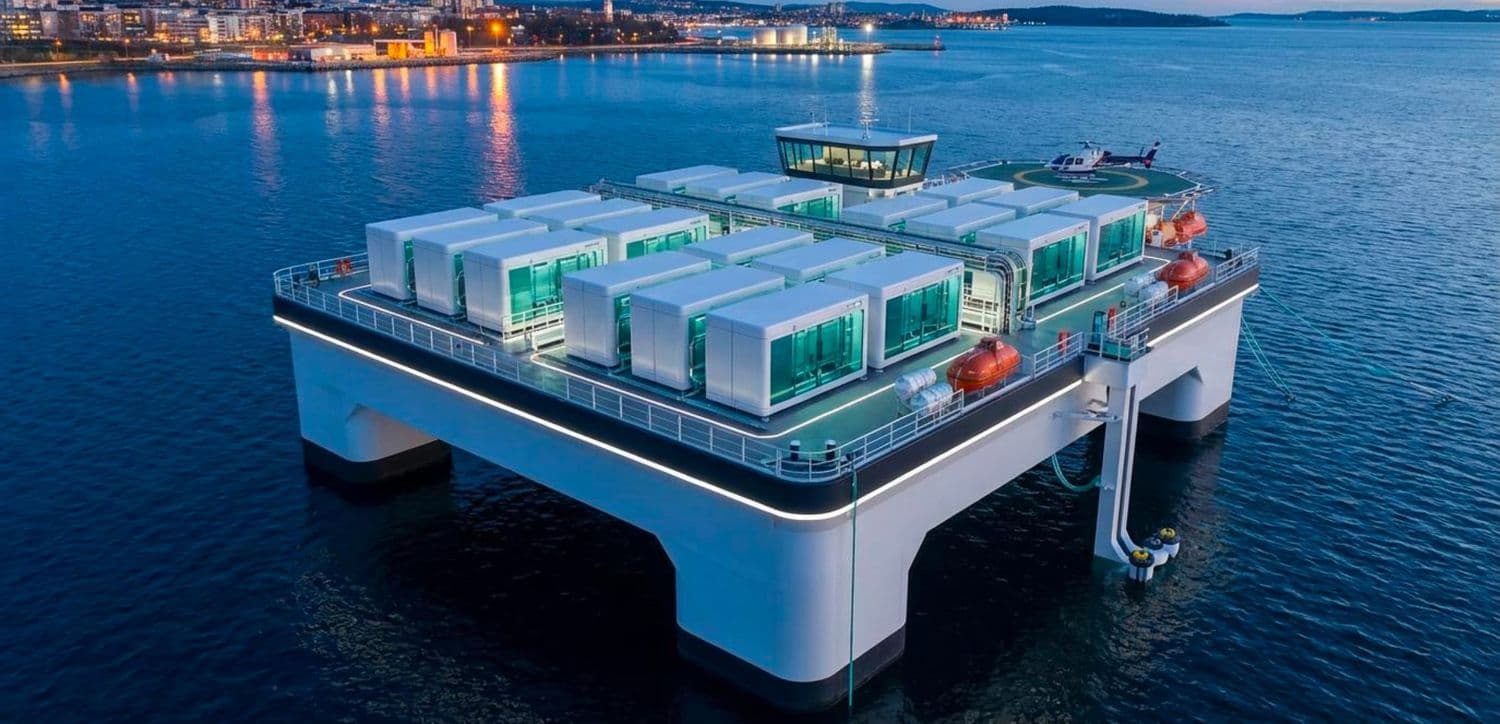
Illustrative image · concept, not an existing installation
Our values
What guides our work
Ecology
Protect coasts and oceans
Our starting point is an environmental emergency: removing a recurring pollution from Caribbean and Atlantic shorelines.
Health & safety
Treat the risk, never shift it
Arsenic, heavy metals, chlorides and sulphur are handled inside the process and concentrated into a small, containable solid stream.
Circularity
Zero waste
An integral valorisation of the biomass: valuable molecules first, energy next, treated water returned to the circuit.
Rigour
Measure, don't assume
Every maturity step is tied to documented work. We always distinguish what is established from what remains to be demonstrated.
Transparency
Name our risks
A project that models its own accident scenarios and states its residual weaknesses is more robust than one that simply asserts safety.
Cooperation
Local roots, shared expertise
Switzerland, Spain, France, French Guiana, the Dominican Republic and Martinique: science, engineering and field knowledge, with local teams trained on site.
Timeline
Two axes, one programme
Our research programme runs in parallel on two axes, each with its own partners and public funding.
Axis 1 · Caribbean
Dominican Republic
Revalena, INTEC, CADE and Algaltek. Feedstock characterisation, seven continuous gasification runs in Albacete, a safety assessment, a study of local agricultural residues and an economic risk assessment. Funded by the Inter-American Development Bank since May 2025, now in its closing phase.
Axis 2 · Atlantic
French Guiana: SARGASOL
Revalena and the Grand Port Maritime de Guyane. Integral, zero-waste valorisation covering cascade extraction and the energy route.
TRL 3
of the full biorefinery, reached summer 2026
The third phase, SARGASOL (2026–2028), is under way within an ADEME and ANR programme.
What has been completed
May 2025
Start of the IDB project
Axis 1 · CaribbeanNov 2025
ADEME agreement
Axis 2 · AtlanticDec 2025
Feedstock delivered to CADE
Axis 1 · CaribbeanMar 2026
Safety assessment
Axis 1 · CaribbeanApr 2026
Characterisation and gasification study
Axis 1 · CaribbeanJul 2026
Feedstock flexibility study
Axis 2 · AtlanticSummer 2026
TRL 3 of the biorefinery reached
Axis 2 · AtlanticAug 2026
Tripartite agreement and supplier proposals
ProgrammeIn progress
IDB final report, SARGASOL under way
Programme
Next step
Scaling up from the pilot platform to demonstration size, in preparation with our technology and scientific partners.
Partners
An international consortium
Revalena Sàrl, a Swiss company based in Geneva, leads the programme. The Grand Port Maritime de Guyane is our historic partner; CADE is our main technology partner.

Grand Port Maritime de Guyane
Historic partner · French Guiana
Official partner that financed a large part of the programme's early development. Sargassum collection logistics and support in port relations. Holder of the SARGASOL agreement.
CADE Soluciones de Ingeniería
Main technology partner · Albacete, Spain
Supercritical hydrothermal gasification technology. Feedstock characterisation and gasification runs on sargassum at its Albacete pilot platform.
INTEC
Scientific direction · Santo Domingo, Dominican Republic
Scientific lead of the Dominican axis: analyses, risk and environmental assessment.

Sargawatt
Sourcing · Martinique
Algaltek SA
Research · St-Aubin (FR), Switzerland
- Laudato Sea
Laudato Sea
Strategic & maritime advisory
Thomas Lockhart
- Alcantara Industries
Alcantara Industries
Industrial engineering
Thomas Rodriguez

Finance for Impact
Techno-economic modelling
Thierry Sénéchal

Assertive Group SA
Ethical negotiation · Geneva, Switzerland
Scientific, local and institutional partners
- EPFL

- UNEV
- SOGEMA · Serd
With the support of



Where it began.
Algaltek SA, an EPFL spin-off, established the science and proof of concept for sargassum valorisation, validated in the Dominican Republic with the IDB. Algaltek then entrusted the industrial development of the biorefinery to Revalena, a company created specifically for this purpose, in continuity with its scientific team.
Contact
Let's talk about your coastline
Local authorities, ports, industrial partners, investors or research teams: we would be glad to hear from you.
- Management
- Sonia Grimm, CEO and Project Director
- Phone
- +41 79 830 48 71
- Address
- Revalena Sàrl
Rue de la Rôtisserie 8
1204 Geneva, Switzerland